Beauty Discoveries Made in Cambridge: From Newton’s Spectrum to Stem Cells
The colour wheel, the word ‘fluorescence’, vitamins, DNA, stem cells and the first webcam — a makeup artist’s tour of the beauty-related discoveries made in Cambridge, and what each one quietly does inside your makeup bag.
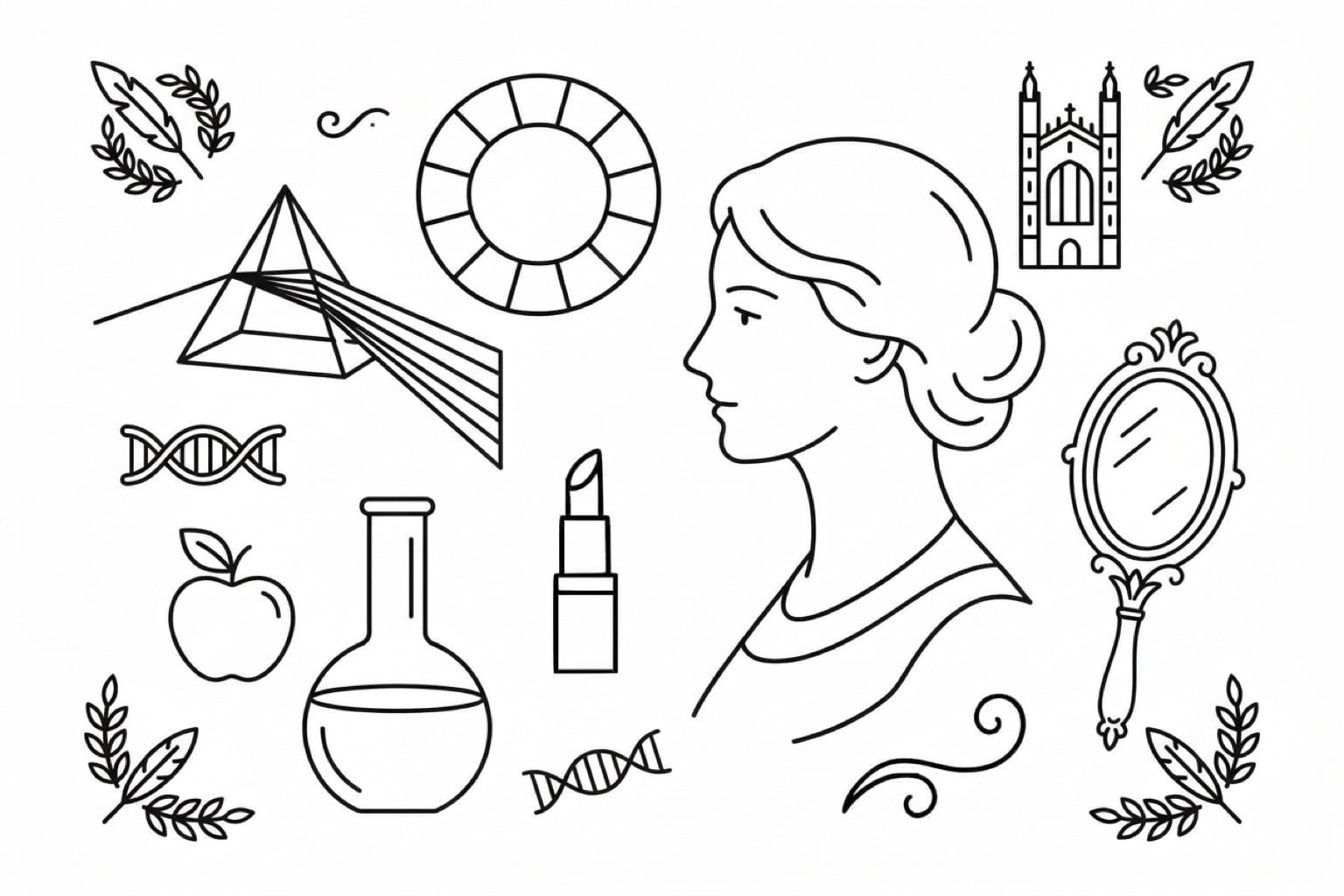
Cambridge is a city that likes to point at its plaques. Turn a corner and there is the pub where the structure of DNA was announced, the laboratory where the electron was found, the college where a young man sat under an apple tree and thought about gravity. What nobody points at is how much of that science ended up, a few centuries or a few decades later, in a makeup bag.
I work in Cambridge and across Cambridgeshire, and I spend my days in front of faces thinking about colour, light, skin and cameras. Every one of those four things was, at some point, worked out here. So this is a slightly unusual journal entry: a walk through the beauty-related discoveries made in Cambridge, some famous and some obscure, with a note on what each one actually does for the person sitting in my chair. Where I say “Cambridge”, I mean the university and its laboratories; where a person only studied here and did the work elsewhere, I say so. I have tried to be honest about the difference, because the city has enough real claims without borrowing.
Newton Splits The Light (Trinity College, 1660s–1704)
Start with the biggest one. In the 1660s a young Isaac Newton, a student and then a fellow of Trinity College, darkened a room, let a beam of sunlight through a small hole and passed it through a glass prism. The white beam fanned out into a band of colours on the far wall. Others had seen that before and assumed the glass was somehow staining the light. Newton did the experiment nobody had done: he passed one colour through a second prism and showed it stayed the same colour. White light was not pure; it was a mixture, and the prism merely sorted it. He announced the result to the Royal Society in 1672 and, decades later, laid the whole theory out in Opticks (1704), which includes something every makeup artist has stared at in training: a circle of colours, arranged so that opposites sit across from each other.
That circle is the ancestor of the colour wheel. It is the reason a green-tinted corrector calms redness, a peach or orange corrector lifts the blue-grey shadow under a tired eye, and a lilac primer brightens sallow skin — complementary colours cancel. When I colour-match a foundation, I am reading warm against cool, yellow against pink, along exactly the axis Newton drew. It is a small pleasure, at a one-to-one lesson, to explain to someone that the trick they have just learned for their dark circles was worked out a few streets away, in a room with the curtains shut.
Young And Maxwell Explain How We See Colour
Newton described the light. Two later Cambridge men described the eye.
Thomas Young studied at Emmanuel College at the end of the eighteenth century (his contemporaries called him “Phenomenon Young”), and in 1801 he proposed that the eye does not have a separate receptor for every colour it can see, but only three, and that every colour we perceive is a mixture of how strongly each of the three is stimulated. That is the trichromatic theory, and it is still, broadly, how we understand colour vision. Young did that work in London, so I will only claim him as a Cambridge student — but it is the theory behind why a foundation that matches in one light can look wrong in another. Your eye is not measuring the pigment; it is measuring three signals, and a warm bulb or a cool grey sky changes the balance. This is why I match foundation at a window and check it under the light of the room you will actually be in, never under the bathroom spotlights.
James Clerk Maxwell was a Trinity man who later returned to Cambridge to found the Cavendish Laboratory. In the 1850s he did painstaking experiments with spinning colour discs to show how three primaries could be mixed to produce almost any hue, and in 1861 he demonstrated the first colour photograph: three black-and-white exposures through red, green and blue filters, projected back together. Every camera that has ever photographed a bride works on Maxwell’s principle. When I say a look has to “read on camera”, this is what I mean — the sensor is doing Maxwell’s three-filter sum, and it does not always agree with the eye about a pink cheek or a red lip.
Stokes Names The Glow (Cambridge, 1852)
Here is the obscure one, and my favourite. George Gabriel Stokes held the Lucasian professorship, Newton’s old chair, and in 1852 he published a paper explaining why certain substances, when lit with invisible ultraviolet light, shine back in a visible colour. He gave the effect its name: fluorescence. He worked it out partly with quinine, which is why a gin and tonic glows faintly blue under a nightclub’s ultraviolet lamp.
What this means for makeup is more practical than it sounds. Fluorescence is why “UV-reactive” festival pigments blaze under black light and why a white shirt looks electric on a dance floor. It is also a cousin of the problem I plan around at every evening event: the way some skincare and mineral powders bounce a camera flash straight back and leave a pale, ghostly cast in photographs. That is reflection rather than true fluorescence, but the lesson is the same — light does things on skin that you cannot see in a mirror, and if you are going to be photographed with a flash at a May Ball or a black-tie dinner, I keep the wrong products off the wrong places.
Hopkins Discovers Vitamins (Cambridge, 1912)
If there is one Cambridge discovery that sits in almost every skincare bottle, it is this one. In 1912 Frederick Gowland Hopkins, working in Cambridge, published feeding experiments showing that animals could not thrive on purified protein, fat, carbohydrate and minerals alone. Something else was needed in tiny quantities — he called them “accessory food factors”. Those factors were vitamins, and the discovery earned Hopkins a Nobel Prize in 1929.
A century on, vitamins are the workhorses of the skincare that I ask brides and clients to start using weeks before a big day: vitamin C for brightness and evenness, vitamin A — retinol and its gentler cousins — for texture and fine lines, vitamin E as an antioxidant, and niacinamide, a form of vitamin B3, for pores and redness. Not every claim on every bottle survives contact with the evidence, but the underlying idea that skin needs these compounds in small, regular amounts goes back to Hopkins’ rats. My advice before a wedding is dull and reliable: a vitamin C serum in the morning, a retinoid you can tolerate at night, and nothing new in the fortnight before the trial. Makeup sits better on skin that has been fed properly.
Watson, Crick And The Molecule Behind “Genetic” Skincare
On a February day in 1953, in the Cavendish Laboratory on Free School Lane, James Watson and Francis Crick worked out that DNA is a double helix — a twisted ladder whose rungs pair up in a way that explains how living things copy themselves. The story goes that Crick walked into The Eagle on Bene’t Street at lunchtime and told the room they had found the secret of life. Rosalind Franklin’s X-ray images, made in London, were essential to the result, and she is now rightly credited alongside them.
The beauty industry has been dining out on the double helix ever since. “DNA repair” creams, “genetic” skincare, personalised routines based on a cheek swab — some of it is real science about how skin cells age and repair, some of it is a molecule’s picture on a box. My honest view, as someone who reads the ingredient lists rather than the front labels: the DNA discovery matters enormously to dermatology and to the drugs that treat serious skin disease, and very little of that has made it, yet, into a moisturiser. Buy the moisturiser for how it makes your skin feel and how your makeup sits on it, not for the helix on the packaging.
Evans And Kaufman Grow The First Stem Cells (Cambridge, 1981)
In 1981 Martin Evans and Matthew Kaufman, working in Cambridge, were the first to isolate and grow embryonic stem cells from mice — cells that can become any tissue in the body. It was one of the foundations of modern regenerative medicine, and Evans shared a Nobel Prize for it in 2007.
You will have seen “stem cell” on a face cream. Here is the honest version. The stem cells in those creams are almost always plant stem cells (apple, grape, edelweiss), and a plant cell extract cannot instruct your skin to regenerate anything. What it can be is a decent antioxidant, which is fine, but it is not the Cambridge science that the name is borrowing. Real stem-cell work in skin is happening in clinics and burns units, not in a jar. When a client asks me whether a product is worth the money, this is one of the phrases I tell them to be wary of.
Köhler And Milstein Make Antibodies To Order (LMB Cambridge, 1975)
At the MRC Laboratory of Molecular Biology in 1975, Georges Köhler and César Milstein worked out how to make monoclonal antibodies — identical antibodies, produced in unlimited quantities, aimed at one precise target. It won a Nobel Prize in 1984 and it created an entire class of medicine.
Where it touches my work is skin health rather than makeup. The modern injectable treatments for severe psoriasis and eczema are monoclonal antibodies, and I have watched clients who spent years hiding flare-ups under heavy foundation arrive at a consultation with calm skin for the first time, needing far less product than they think. If your skin condition is the reason you wear makeup the way you do, it is worth a conversation with a dermatologist before a conversation with me — the Cambridge science in that direction has moved a very long way.
Hodgkin And Huxley Trace The Nerve Impulse (Cambridge, 1952)
Alan Hodgkin and Andrew Huxley, working in Cambridge’s Physiological Laboratory (and on squid at the marine station in Plymouth, because squid have conveniently enormous nerves), described in 1952 exactly how an electrical impulse travels along a nerve. It is one of the great achievements of physiology and it earned them a Nobel Prize in 1963.
I include it because so many of my clients ask about wrinkle-relaxing injections, and the way those work is by interrupting the signal between a nerve and the small muscle it controls, so the muscle stops creasing the skin above it. The signal being interrupted is the one Hodgkin and Huxley mapped. I do not offer injectables and I never push anyone towards them; makeup can soften a line very well and a good natural, skin-first face does not depend on a needle. But if you are considering treatment before a wedding, do it months ahead, not weeks — the result settles, and the trial needs to see the real you.
Darwin On Blushing (A Christ’s College Man, 1872)
This one was not made in Cambridge, but the man was, so it earns a paragraph. Charles Darwin, who read for his degree at Christ’s College, devoted a whole chapter of The Expression of the Emotions in Man and Animals (1872) to blushing, which he called the most peculiar and the most human of all expressions. He noticed that people blush on the face and neck but not elsewhere, that we blush when we think others are looking at us, and that a blush cannot be faked.
Which is, of course, the entire reason blusher exists. A flush of colour on the cheek is the body’s own signal of youth, warmth and being alive, and every product from Georgian rouge to a modern cream blush is an attempt to put it there on purpose. The trick Darwin would appreciate is that a real blush sits high on the cheek and fades softly at the edges — so that is where I put it, and I never draw a hard line.
The First Webcam (Computer Laboratory, 1991)
In 1991 the coffee pot in the Trojan Room of the university’s Computer Laboratory was pointed at by a small camera, so that the people working down the corridor could check whether it was worth walking over for a cup. It went onto the young World Wide Web in 1993 and became the first webcam anyone had heard of. It was switched off, to global mourning, in 2001.
Every video call, every selfie ring light, every “camera-ready” brief I have ever been given descends from that coffee pot. Camera-ready makeup is a real discipline: a phone or laptop camera flattens the face and exaggerates shine, so the answer is more definition in the brows and lashes, a touch more warmth in the blush, and matte where the light will hit. If you are being interviewed on screen, presenting online or having headshots taken, that is exactly the brief for a commercial booking, and it is not the same face I would build for a candlelit dinner.
Turing’s Machine And The Screen In Your Hand
Two last ones, briefly. Alan Turing, a fellow of King’s College, published the 1936 paper that described a universal computing machine — the theoretical ancestor of every computer, including the phone running a virtual try-on app or a foundation shade finder. Those apps are clever and improving, and they are still guessing from a photograph taken in unknown light, which is why the shade they suggest is a starting point rather than an answer.
And the bright, saturated screen you may be reading this on has a Cambridge story too: in 1989 a team at the Cavendish Laboratory made the first light-emitting polymer diode, the seed of the OLED displays now in most phones. If you have ever tried to copy a lip colour from a tutorial and found the real thing looked nothing like it, the display was part of the problem. Screens show a colour brighter and cleaner than any pigment on skin can be, which is another good reason to test a lipstick in daylight before you commit.
What All This Means In The Chair
None of this is required reading for a wedding morning. But it does explain how I work, and why I am a little stubborn about certain things. I match colour by a window because of Young; I check it against the room’s light because of the three-signal sum; I keep certain powders off the nose and cheekbones because of what light does under a flash; I ask brides to start their vitamins early because of Hopkins; and I am politely sceptical of a great many words on a great many jars, because I have read what the science underneath them actually says.
Cambridge is a city that measured the light, mapped the nerve and grew the cell. The least I can do is put a face together properly. If you would like that face to be yours, for a wedding, a ball, a shoot or simply to learn how to do it yourself, tell me about the day.